 |
 |
 |
 |
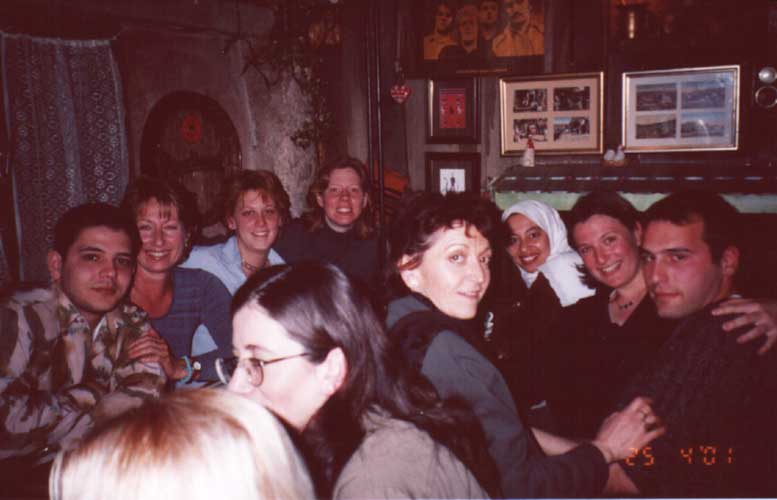
Judging by Tanya’s level of Bosnian, one might not think that she ever did a course in the language. Well here’s proof: here we are with the rest of the class members and the teacher at “Avlija” – the quaintest courtyard restaurant imaginable. |
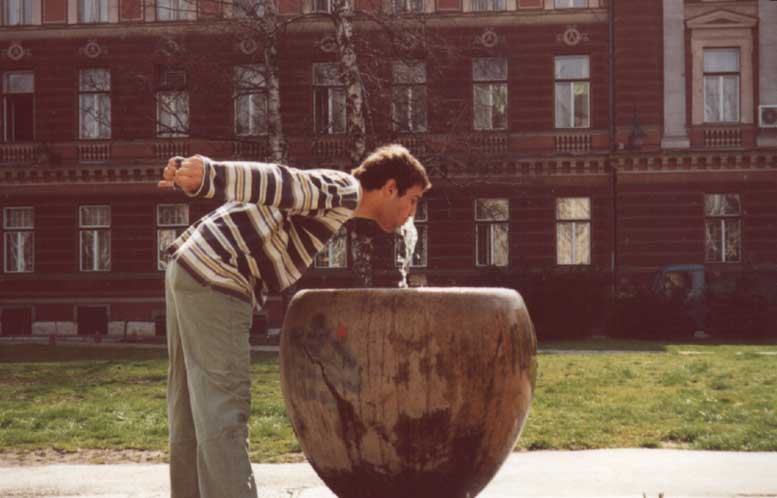
We
weren’t quite sure if the water was actually intended for drinking
or if it was just a decorative fountain, but Branko was thirsty. This
was behind Ali Pasha's mosque…
|
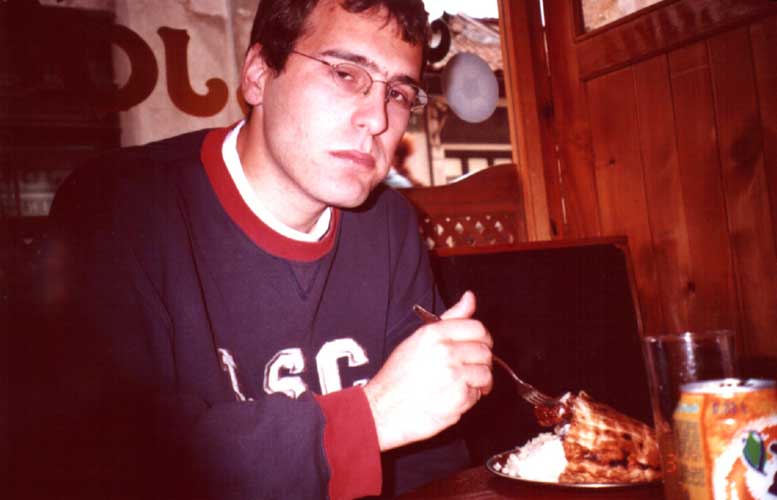
Cevapi.
Cevapcici. Pronounced “Chevapi” or “Chevapchichi”
where the first “ch” and the second “ch” are
not the same at all. The bottom line is that this dish of braaied
minced meat in soft pita with chopped onions is absolutely delicious
and clarifies the reason why for weeks before the trip, all Tanya
heard about was cevapi. (Or cevapcici…) |
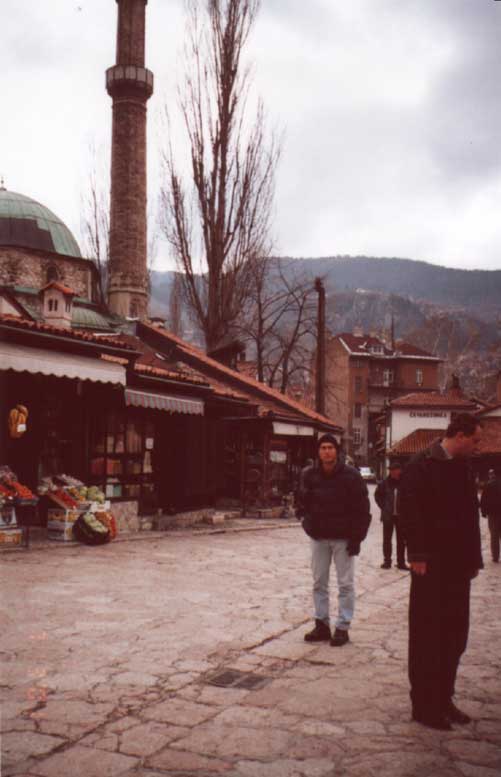
Here is Branko at Bascarsija (pronounced Bashcharshiya), which means “the exact middle of the town”. The reason why you wouldn’t see a picture of Tanya in the same spot is that the place is usually filled with hundreds of pigeons being fed by people who don’t understand just how filthy the creatures actually are… |
| Back
to the Our Trips Page |
Back
to the Our Trips Page |
Back
to the Our Trips Page |
Back to the Our Trips Page |
 |
 |
 |
 |
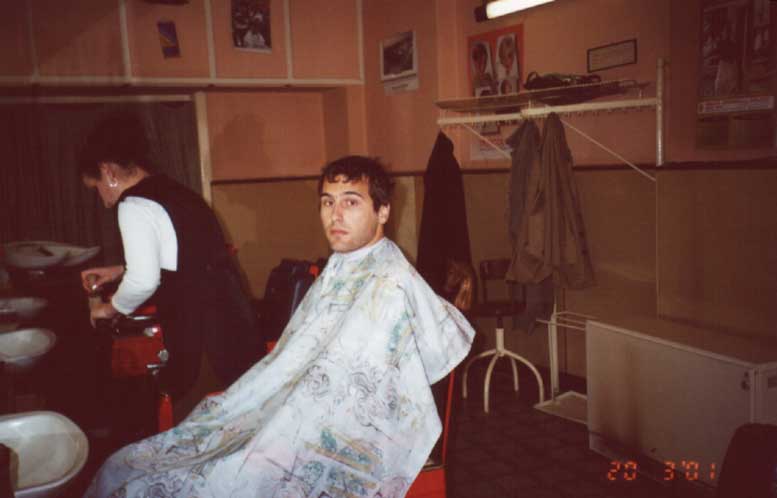
Branko decided
to have his hair cut for purely sentimental reasons (it had nothing
to do with his scraggly head.) If you look carefully in the background,
you may notice a wooden horse/chair. This is the same barber shop
where Branko had his hair cut throughout his childhood so how could
he not go back there for old time's sake? He begged to be allowed
to sit on the horsey but he's just a little too large... |
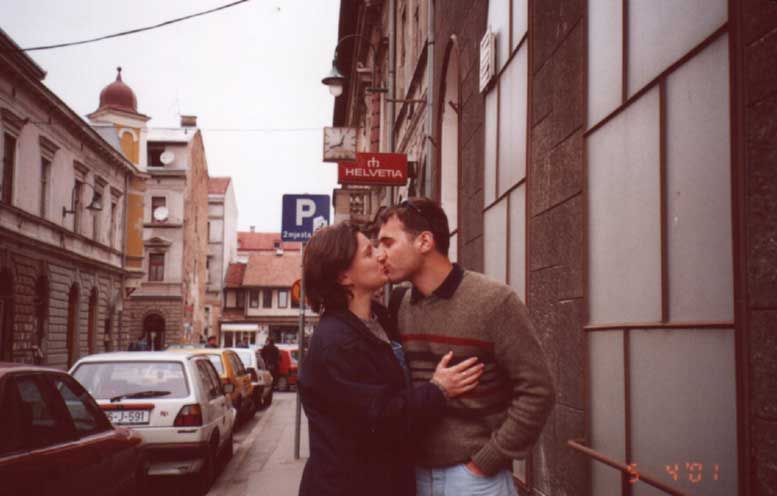
Ahhh - what a romantic place
for a kiss... This is the spot where Gavrilo Princip shot Archduke
Franz Ferdinand, triggering the first world war. The spot used to
be marked with footsteps engraved in the concrete but they were removed
after the war because Princip was a Serb and we all know that Bosnians
don't like Serbs. Rumour has it that they are now back in place (the
Bosnians have woken up to the value of national history) so another
trip to Sarajevo may be in order just so that we can make sure... |
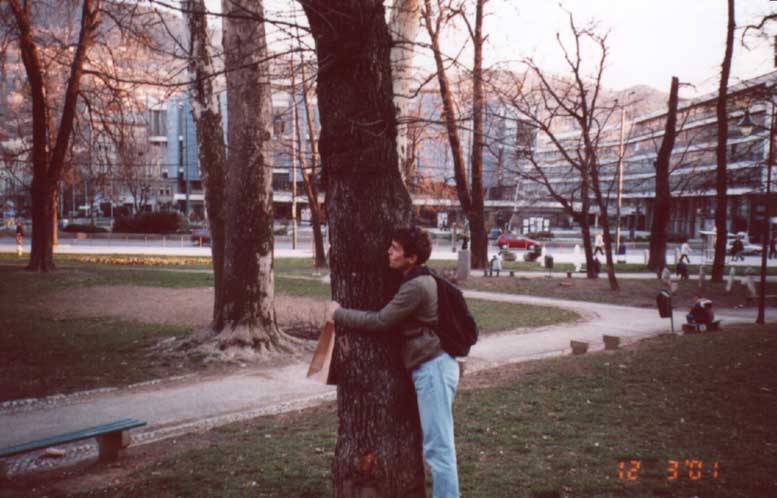
And while we're talking
about kissing, Branko may be just a little too connected to his roots...
Who ever heard of kissing a tree just because it's Bosnian?!? |
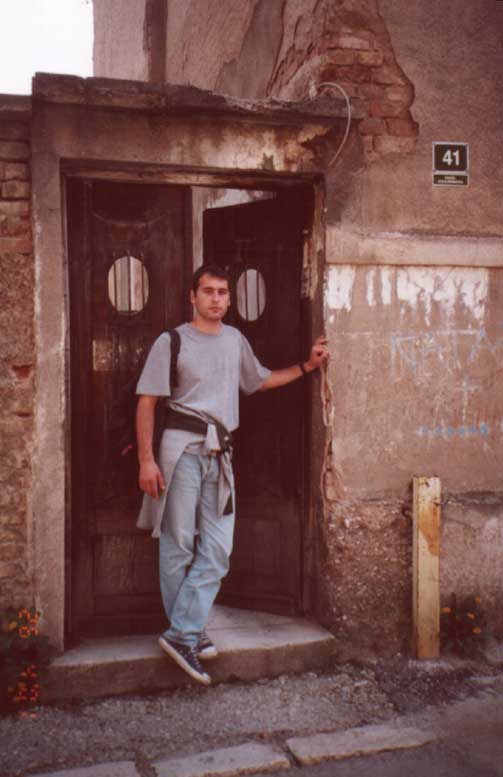
The two giggling girls in the street were very
generous to allow us to take this picture of Cvjetko and Jefa Rihtman's
home in the Mejtas neighborhood of Sarajevo. Tanya was particularly
interested in seeing the home where Ranko grew up and in which Branko
spent so much time with his grandparents. |
 |
 |
 |
 |
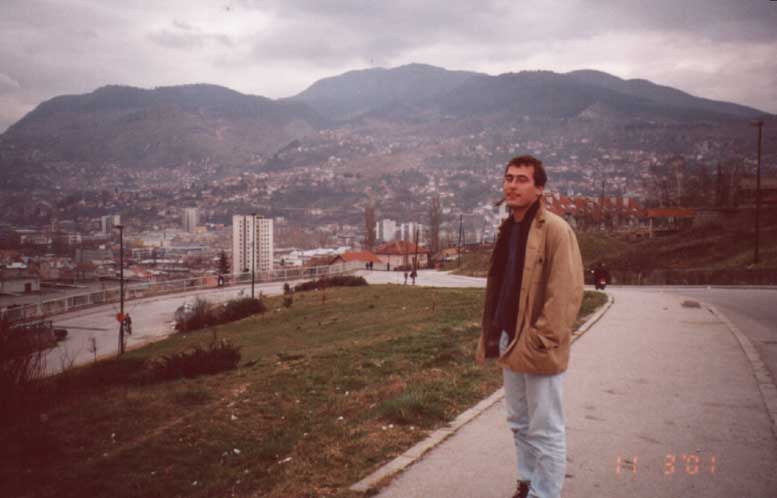
Here is Branko
near his uncle Braco's house in the Kosevo (pronounced Koshevo and
having nothing to do with a different Yugoslavian/Albanian area of
conflict) neighborhood of Sarajevo. What a view! |
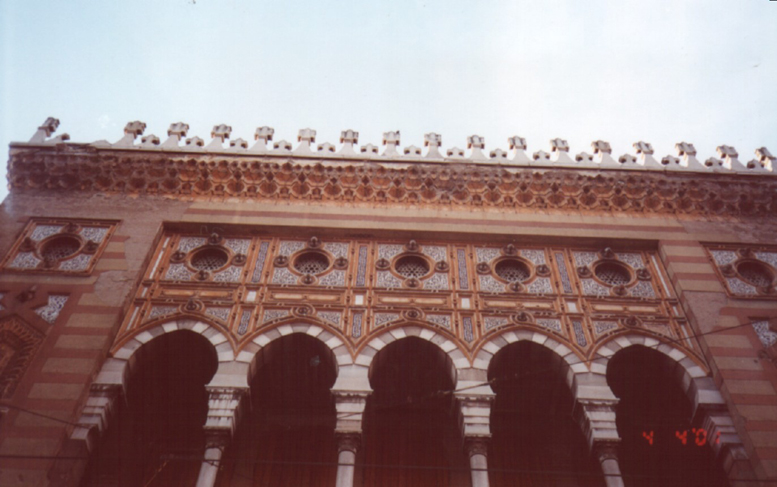
On August 25, 1992, in a
planned attempt to wipe out the whole history of the Bosnian nation,
Serbs attacked Bosnia's National Library which housed a collection
of 1.5 million volumes, including 10% rare, archival documents. Over
the next three days, the building was completely gutted and the greater
part of its contents were destroyed. Continuous shelling on the building
kept the fire going and limited attempts to rescue the building's
contents. Despite the dangers, civilian volunteers formed a human
chain to pass the books out of the library, but only saved less than
10% of the library's contents. The library is still a beautiful building
from the outside but people are not yet allowed to enter the deserted
structure. |
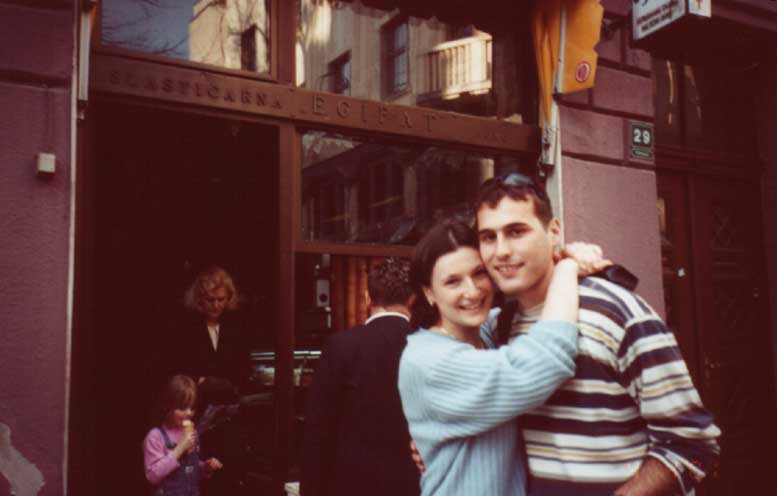
The real focus of this picture
is not Branko and Tanya, but the building behind them: Egipat Confectionary.
Talk about cultural heritage - they sell the best caramel ice-cream
in the world! Branko wasn't exaggerating one bit! |
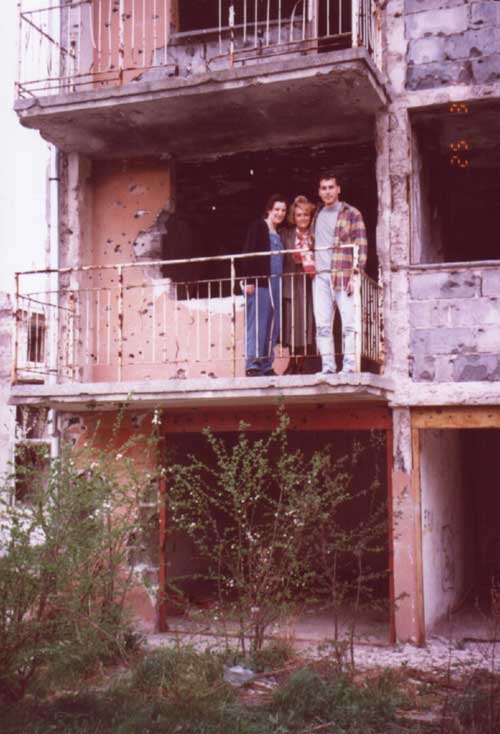
Branko's aunt and uncle's home in the Aerodrom
neighborhood of Sarajevo. This area was one of the front lines of
Bosnian-Serbian fighting. They don't live there anymore but then that
may be quite obvious... Since we were there, the building has been
renovated and the huge, gaping hole in the middle of the living room
floor has been repaired. |
 |
 |
 |
 |
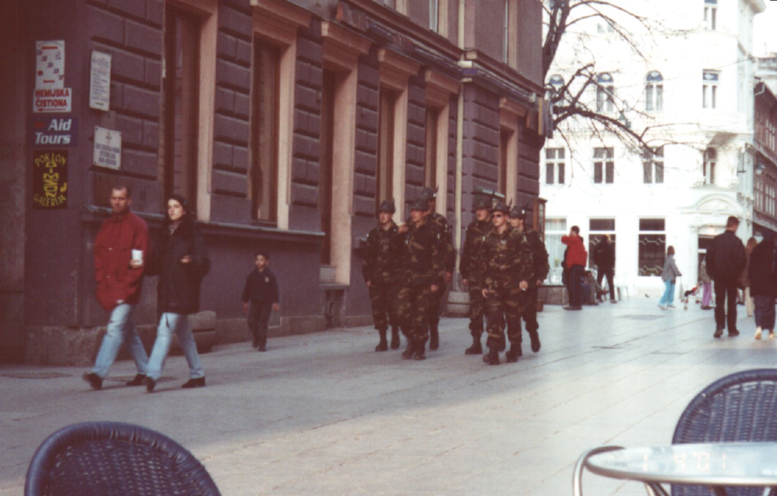
The United Nations
peace-keeping forces perform a vital role in Bosnia (right!). Here
in downtown Sarajevo are the Italian soldiers who are easily recognizable
by the feathers in their caps. Don't they know that people are laughing
at them? |
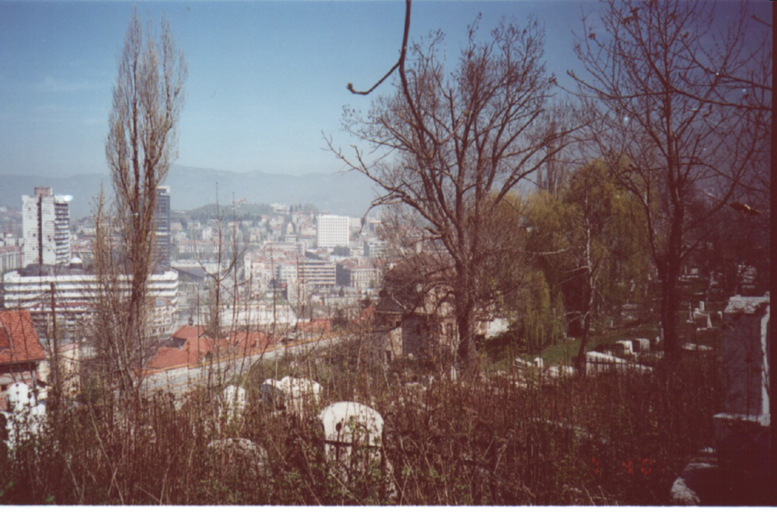
This is the view of Sarajevo
from the old Jewish cemetery. Because of the position of the cemetery,
a Serbian sniper was permanently positioned behind the tomb stones
during the war to shoot into the city. Tanya didn't join Branko and
Galit's outing to this cemetery and was pleased that she only heard
the rumour about mines between the graves after they came home safe
and sound! |
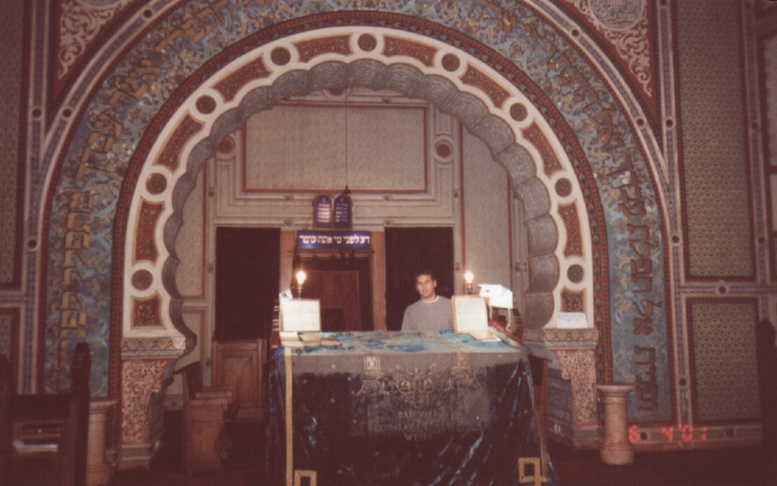
Sarajevo's Jewish community
building houses a synagogue that was built in 1902. Although the community
is predominantly Sephardi, this (believe it or not) Ashkenazi shul
is the only functioning one in Sarajevo today. Even then, the only
time we actually prayed in the main shul was on Pesach, but it was
an experience worth waiting for. |
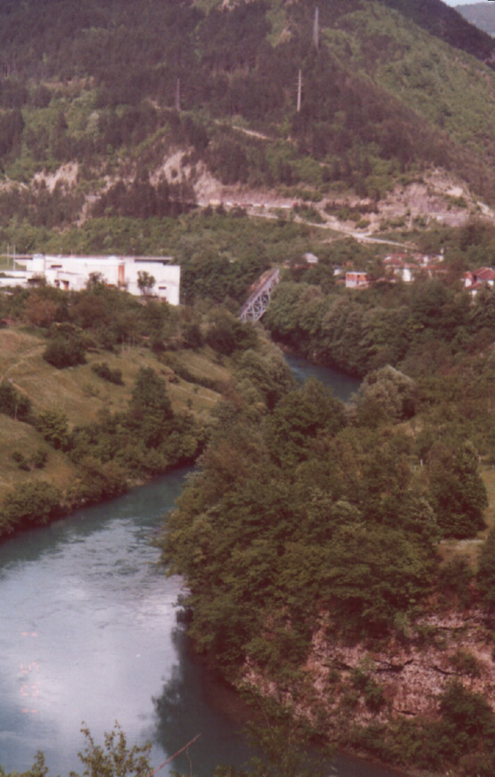
The broken bridge over the Neretva river in Jablanica
is a monument to the military genius of the much-loved Tito. In March
1943 Yugoslav partisan forces were in the Neretva valley with 4500
wounded and enemy forces behind them and on the other side of the
only bridge. Tito ordered the bridge destroyed and during the night
built a provisional foot-bridge and transferred all the troops and
injured past the enemy camp on the other side. This picture was taken
on May 1, 2001 on the way to eat lamb on the spit... Yummmm |
 |
 |
 |
 |
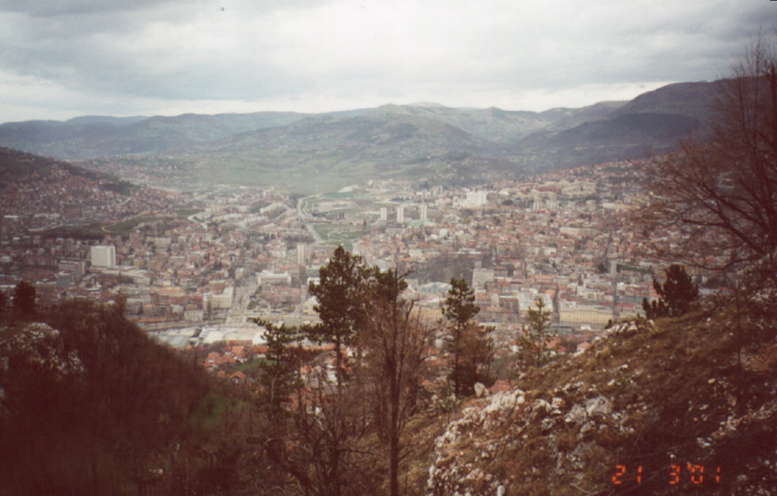
Yet another
view of the beautiful city of Sarajevo. This one was taken from Vraca
where we stopped on out way to Jahorina to see some snow... |
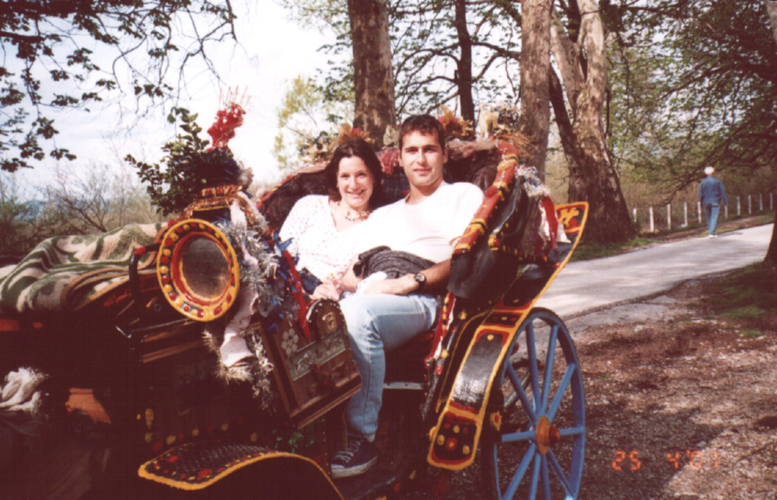
Branko took
Tanya for a surprise outing to Vrelo Bosna, the natural mountain-water
springs surrounded by beautiful mountains in Sarajevo. There are two
ways to get there - by tram for most of the way and then walking the
rest or in cute horse-drawn carts that go along a magnificent tree-lined
path. Tanya's treat was this carriage ride and a daisy chain made
for her by Branko. |
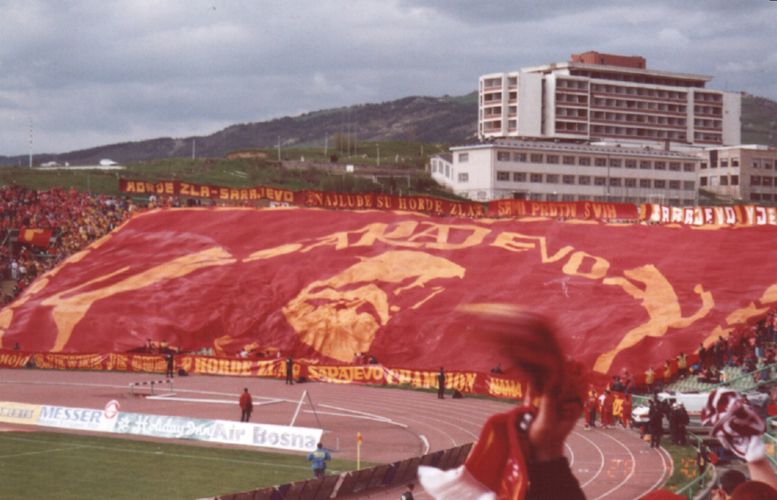
Sarajevo has two football
teams - Sarajevo and Zeljo and even if you hate the game, you MUST
chose a team if you want to call yourself a Sarajevan. The Sarajevo-Zeljo
derby is quite a big deal and Tanya (who had become quite the football
match regular and needless to say a sworn FC Sarajevo fan) accompanied
Branko to the event. This is a HUGE emblem of FC Sarajevo covering
one side of the Olympic stadium - yes, there are people under there
and no, it doesn't matter that they can't see the game... |
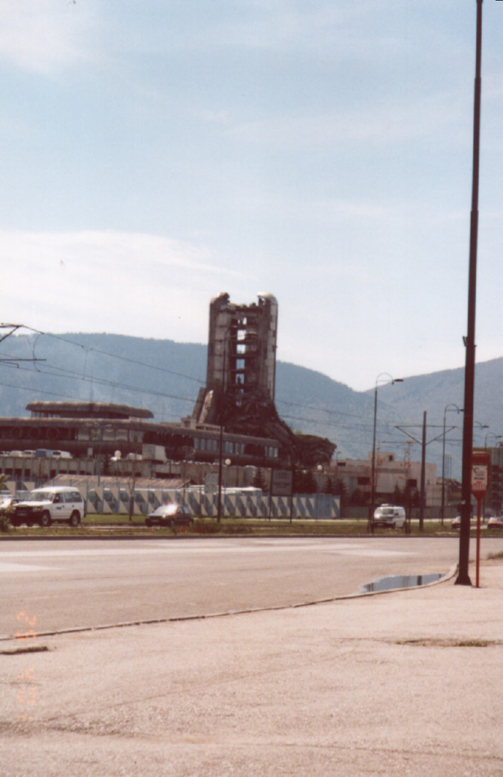
The Oslobodjenje newspaper building was heavily
attacked during the war but despite the damage, the paper printed
an edition every day of the four-year siege of the city because of
the importance to keep the city informed. The printing press was operated
from the basement and employees came to work for a week at a time.
The building has not been renovated and remains as a monument to the
destruction of the war. |
 |
 |
 |
 |
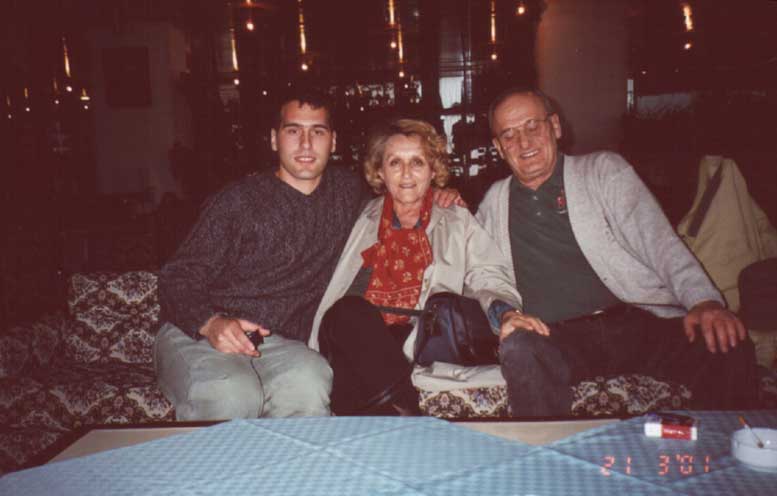
Branko with his Aunt Nada
and Uncle Braco in the Olympic Hotel on Jahorina. It's so much more
simple in English: you just say aunt or uncle. In Bosnian, you have
striko, strina, tetak, tetka and a whole lot more, each of which tells
you the EXACT familial relation with the person in question. So, if
you must know, this is Branko with his Strina Nada (wife of father's brother) and Strika Braco (father's brother.) |
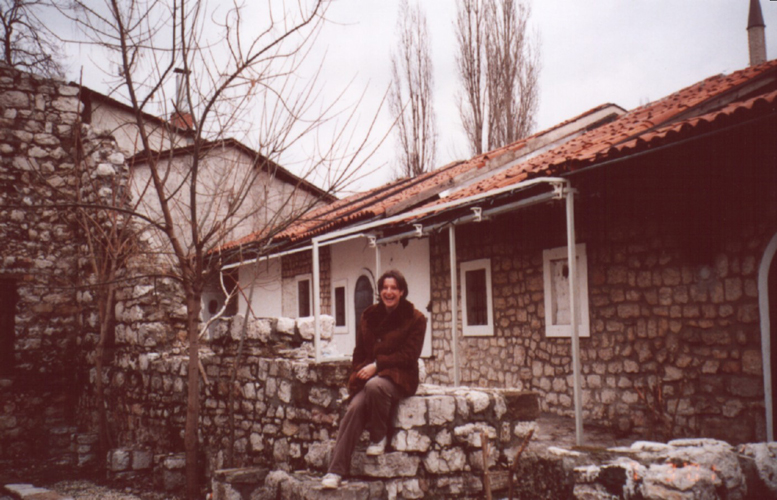
Tanya in the middle of the
old town of Sarajevo on one of the first days in Bosnia when she was
still enthusiastic about wearing that very thick coat... |
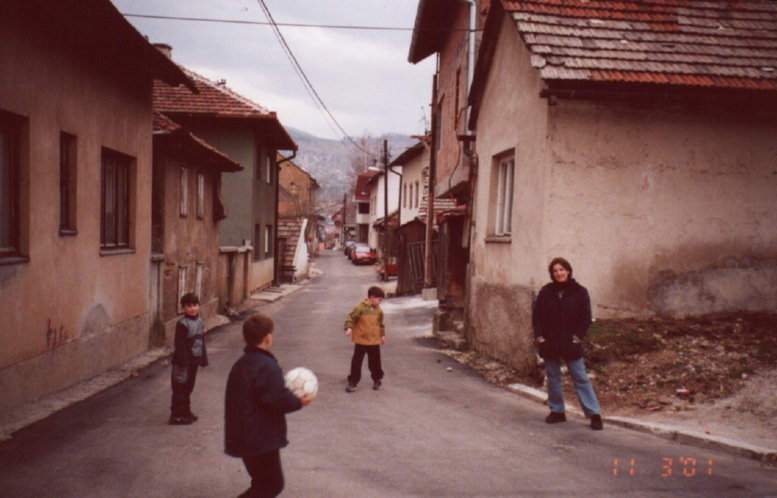
Kids will play football
wherever you may go - especially if they're Bosnian. This was taken
while roaming the Kosevo (pronounced Kosh-e-vo) neighbourhood after
lunch at Braco and Nada. The kids kept on playing regardless... |
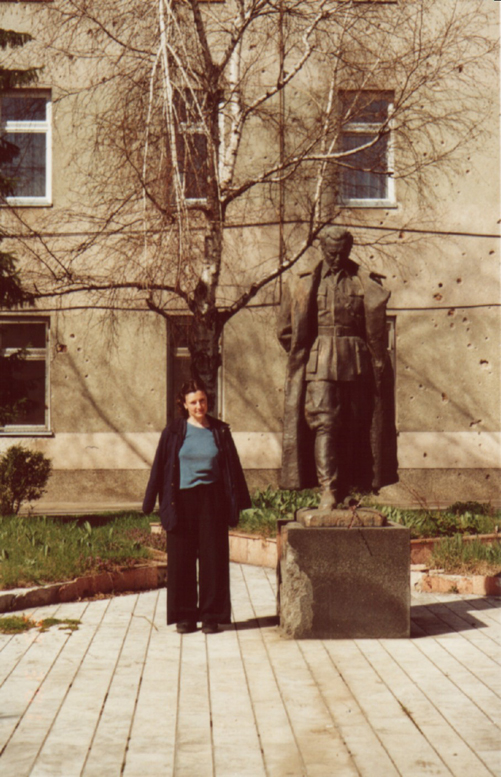
Tanya and Tito. How could she miss the opportunity? |
| Back
to the Our Trips Page |
Back
to the Our Trips Page |
Back
to the Our Trips Page |
Back to the Our Trips Page |